

Local SEO for Multiple Locations: Best Practices & Multi-Location SEO
Boost your online presence with local SEO strategies for multi-location business. Enhance each business location listing with multi-location SEO and multiple location SEO.

Multi-Location Local SEO fails when brands try scaling single-location tactics across 50 cities by copying pages, swapping city names, and hoping Google rewards them with Map Pack visibility. That approach triggers spam filters, thin content penalties, and creates a management nightmare where updating one detail means manually editing hundreds of pages. According to Moz’s Local Search Ranking Factors, businesses with multiple locations face unique challenges that require fundamentally different seo strategy for multiple locations than single-location optimization.
Key Takeaways:
Multi-location brands need an entity strategy that separates the parent organization from individual branches in search engine knowledge graphs.
Site architecture decisions like subfolder structure and internal linking logic determine whether you scale without triggering doorway page penalties.
Each location page must balance core brand content with genuine local keywords and market-specific context to satisfy both users and search engines.
Managing Google Business Profile listings, schema markup, local citations, and review generation requires different workflows and tools at scale.
AI search surfaces like SGE and Bing Copilot change how multi-location businesses appear in search results and conversational answers.
The successful multiple location seo strategy treats your brand as a hub and each physical location as a spoke. This means building technical foundations that tell Google how your entity structure connects, creating local landing pages that mix standardized messaging with real local context, and managing your business listings through systems that maintain consistency across all locations without manual updates. Miriam Ellis is a local search expert and former Local Search Quality Analyst who notes that “the biggest mistake multi-location brands make is treating each location like an independent business instead of leveraging the parent brand’s authority.”
This guide walks through all eight phases of scaling local search engine optimization for multiple locations without creating spam signals or losing control. Whether you operate 10 locations or even thousands of locations, these principles apply.
Foundation and Entity Strategy
Before you build local landing pages or optimize Google Business Profile listings, you need to map your service areas and define how search engines should understand your brand hierarchy. This phase determines whether Google connects your individual locations to your parent organization correctly or treats them as disconnected entities competing against each other.
Most multi-location businesses skip this step entirely.
They launch pages based on whoever asks loudest or whichever local market feels urgent that week. This creates inconsistent signals in Google’s knowledge graph, orphaned locations that never rank, and wasted effort when you realize six months later that your entity structure needs complete rebuilding. The right sequence saves months of rework: define your entity hierarchy first, prioritize your must-win markets second, then build third.
Structuring Your Brand vs. Your Branches
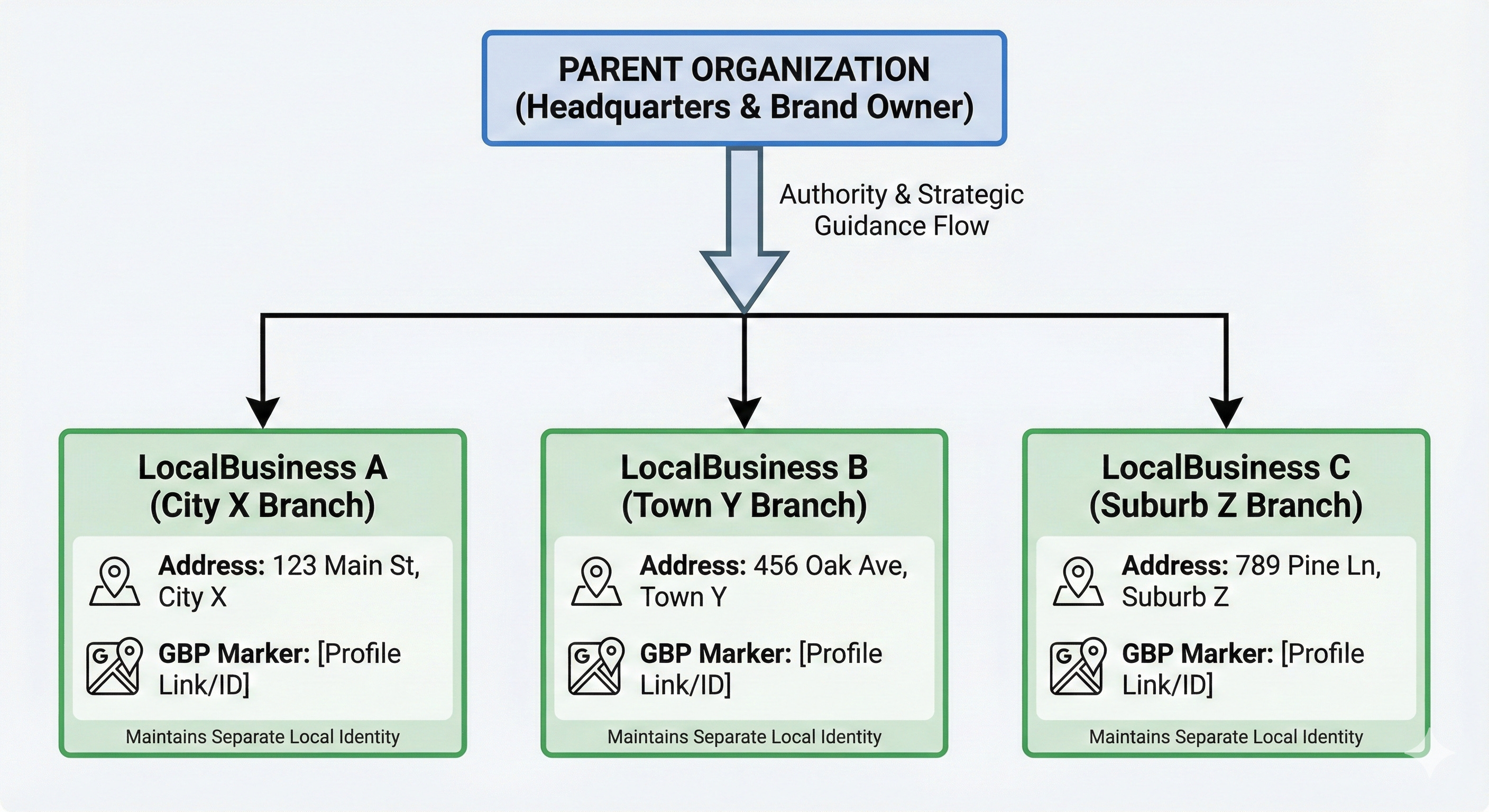
Google sees your multi-location business as two distinct entity types that must connect properly for local seo for multi-location businesses to work. The parent organization exists as one entity with brand identity, value proposition, and overall service offering. Each physical business location exists as a separate entity with its own address, phone number, operating hours, and local reputation signals.
Your job is connecting these entities without confusion.
If you treat every location as a standalone brand with no parent connection, you lose the authority and trust signals that come from being part of a larger organization. If you merge them all into one entity, Google cannot rank you in local search because it does not know where you physically operate or which location serves which service area.
The solution mirrors franchise models. McDonald’s operates as the parent organization. The McDonald’s at 5th and Main operates as a LocalBusiness entity. Google understands they connect but ranks them separately for different search queries based on user intent and location.
Pro Tip: Structure your homepage content around Organization schema and brand-level messaging. Structure your location pages around LocalBusiness schema and market-specific details. Use schema’s parentOrganization property to explicitly connect them in code.
Mapping Your Service Areas
Not every city deserves equal investment when scaling local SEO for multiple locations. You need a priority framework that separates must-win markets from secondary markets from markets you ignore until business conditions change.
Your three market tiers:
Must-win markets: Cities where your revenue potential, competitive advantage, or existing customer base justifies full optimization across all eight phases. These get dedicated location pages, optimized business listings, local link building campaigns, and active review generation. You build these first and measure everything because they fund your expansion.
Secondary markets: Cities that receive basic location pages and standard GBP setup, but you delay advanced local SEO work until your priority markets perform and prove which tactics move rankings. This prevents spreading budget too thin across too many locations simultaneously.
Ignore markets: Areas where you might operate someday but currently have no physical presence, no immediate revenue opportunity, or no operational capacity to serve well. Building pages for these creates doorway page risks with no upside.
Did You Know? According to BrightLocal’s Local Search Industry Survey, 64 percent of agencies cite “managing multiple business locations” as their biggest local SEO challenge, primarily because they try optimizing too many locations at once instead of prioritizing strategically.
The prioritization framework weighs four factors together:
Search volume: Indicates demand in that local market
Competition level: Shows ranking difficulty and required investment
Revenue potential: Projects financial return from improved visibility
Operational capacity: Confirms you can serve that market excellently
If you cannot serve a market well or measure local SEO efforts there, it does not belong in your first phase. This approach focuses your team’s time, your marketing budget, and Google’s crawl budget on locations that generate measurable business outcomes rather than vanity metrics.
Learn how to audit your current entity structure, prioritize markets using a scoring matrix that weighs search volume against competitive difficulty, and map your service areas for maximum ROI. This spoke covers the complete process with spreadsheet templates you can implement this week.
Technical Site Architecture & URL Structure
Getting your URL structure wrong at launch means migrating hundreds of pages later, redirecting dozens of internal links, and risking temporary ranking drops while search engines recrawl everything. This phase locks you into either a scalable system that supports growth or a maintenance disaster that consumes hours weekly just keeping pages consistent. Understanding these technical seo issues early prevents expensive fixes later.
The core decision shapes everything downstream.
How do you organize location pages in your site hierarchy so Google understands the relationship between your homepage, state pages, city pages, and service pages? The answer determines how authority flows through your site, how users navigate between locations, and whether you can push updates across multiple locations without custom development work or manual editing. This architectural planning seo involves careful consideration of how each location connects to your parent brand.
Subdomains vs. Subfolders: The Verdict
Subdomains treat each location as a separate site with its own technical foundation. You end up with newyork.yourbrand.com, chicago.yourbrand.com, and miami.yourbrand.com.
Why subdomains create problems for multi-location SEO:
Split your domain authority across multiple properties
Prevent link equity from flowing naturally from homepage to location pages
Require separate sitemaps, analytics setups, and schema implementations
Multiply technical maintenance across every subdomain
Make search engines treat each location as a distinct entity
Subfolders consolidate everything under one domain for stronger SEO performance.
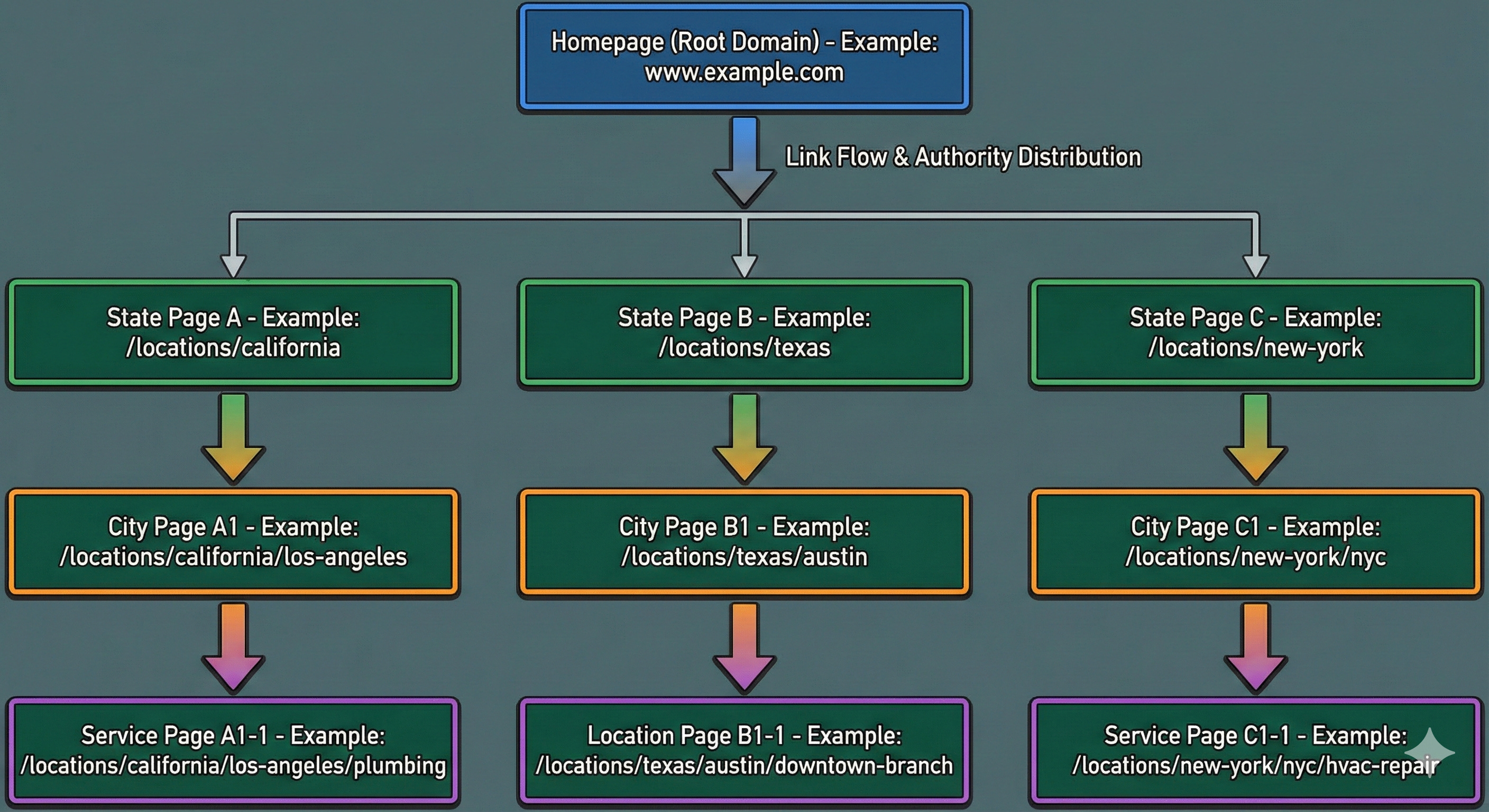
You use yourbrand.com/locations/new-york, yourbrand.com/locations/chicago, and yourbrand.com/locations/miami.
Why subfolders win for most multi-location brands:
Authority flows naturally from homepage through internal link structure
One sitemap, one analytics property, one schema system to manage
Updates roll out across all locations from a single template
Easier to track performance across multiple locations in one dashboard
Simpler technical maintenance as you scale
John Mueller, Google Search Advocate, has stated in Google Search Central videos that subfolders and subdomains are treated similarly by Google’s algorithms, but subfolders make it easier to consolidate authority signals and manage technical SEO at scale. For most multi-location brands pursuing consistent local SEO strategies, subfolders win.
Expert Pick: Use the subfolder structure /locations/state/city or /locations/city depending on how many locations you operate. This creates clear hierarchy, supports future expansion, and keeps all location pages under one domain authority umbrella.
The exception applies when you operate genuinely different brands across various locations. A franchise model where each location has its own brand identity, its own team managing the site, and its own customer base might justify subdomains. For unified multi-location brands, subfolders deliver better results with less ongoing work.
Internal Linking Logic
Your internal link structure tells search engines how your pages connect and how authority should distribute across your site. The cleanest pattern for multiple location SEO flows from broad to specific: homepage links to state or region pages, state pages link to city pages, city pages link to service pages or individual location pages.
This creates hierarchy that search engines understand efficiently.
The effective internal linking pattern:
Homepage passes authority to state or region hub pages
State pages link to all city pages within that region
City pages link to service-specific pages for that location
Service pages link back to the relevant city page and related services
Horizontal links connect related pages (Austin plumbing to Dallas plumbing)
Your homepage passes authority to your top-level location landing pages. Those pages pass authority down to more specific local pages. Google crawls logically by following clear paths from general brand information to specific local offerings. This improves how quickly new pages get indexed and how authority flows to pages that need it most.
The failure pattern happens when brands build hundreds of location pages with no connecting structure:
Homepage links to nothing local
Location pages link randomly to each other or only back to homepage
Search engines cannot determine which pages matter for local search queries
Crawl budget gets wasted on orphaned pages that never rank
Authority dilutes instead of concentrating where needed
Pro Tip: Your internal linking should also connect horizontally between related pages. A page about plumbing services in Austin should link to other Austin service pages and to plumbing pages in nearby cities where relevant. This reinforces topical relevance for both users and search engines.
The structure also determines how you handle service area pages versus physical business location pages. If you have a physical office in Austin but serve the entire metro area, your URL structure should make clear whether your Austin page represents the office location for local pack rankings or the service area for broader visibility. According to Search Engine Journal’s technical SEO guide, this distinction affects how Google interprets your location pages for different search queries.
Clarity at the URL level prevents confusion in Google’s understanding of your online presence.
Learn the exact folder structure, naming conventions, and internal linking patterns that scale to 100+ locations without creating orphan pages or diluting authority. Includes template examples for different business models and migration guides if you need to restructure existing pages.
The “Location Page” Content Framework
You can build 50 location pages in a weekend by copying your template, running find-replace on city names, and publishing everything at once. Google can de-index all 50 pages in a month for violating doorway page policies that protect search results quality. The line between scaled content and spam is thin, and most brands pursuing multiple-location seo cross it without realizing the damage until rankings disappear completely.
The challenge demands balance.
You need enough unique, valuable content for each location page to pass Google’s quality filters while maintaining brand consistency and managing updates efficiently across dozens or hundreds of pages. Single-location content strategies do not scale. Pure automation creates spam. The solution requires a structured system that separates what stays consistent from what must change when you use local context appropriately.
Avoiding the “Find/Replace” Trap
Google’s doorway page guidelines target pages that exist only to rank for specific search queries without providing real value to users searching for local businesses. The classic violation pattern repeats identical content across multiple pages with only the city name swapped in headlines and a few sentences.
The pattern Google’s algorithms flag:
Identical headlines with only city names changed: “Best Plumbing Services in [CITY]”
Same service descriptions repeated across all location pages
Process explanations that never vary by market
Only differences are city name mentions and stock skyline photos
No location-specific questions answered
If a user in Austin lands on your Austin page and sees exactly what someone in Dallas sees on your Dallas page, you are running a doorway page strategy that violates Google Search quality standards.
The trap catches brands because surface-level changes feel like enough differentiation:
Adding a stock photo of the city skyline
Mentioning a local sports team in one sentence
Embedding a Google Map pointing to that city
Changing a few words while keeping 95 percent identical
These cosmetic touches do not change the fact that the core content remains identical, the value proposition stays generic, and the page answers no location-specific question a user might actually search for in that local market.
Did You Know? Lily Ray, Senior SEO Director at Amsive Digital, noted in her analysis of Google’s Helpful Content Update impacts that “thin location pages are among the most commonly penalized content types because they provide no unique value compared to competitors serving the same markets.”
This is not about hitting a specific word count or uniqueness percentage measured by tools like Copyscape. It is about whether each page serves a genuine purpose for someone searching in that specific location. If your page does not answer questions unique to that market, it does not deserve to rank in local search results there.
The Modular Content System
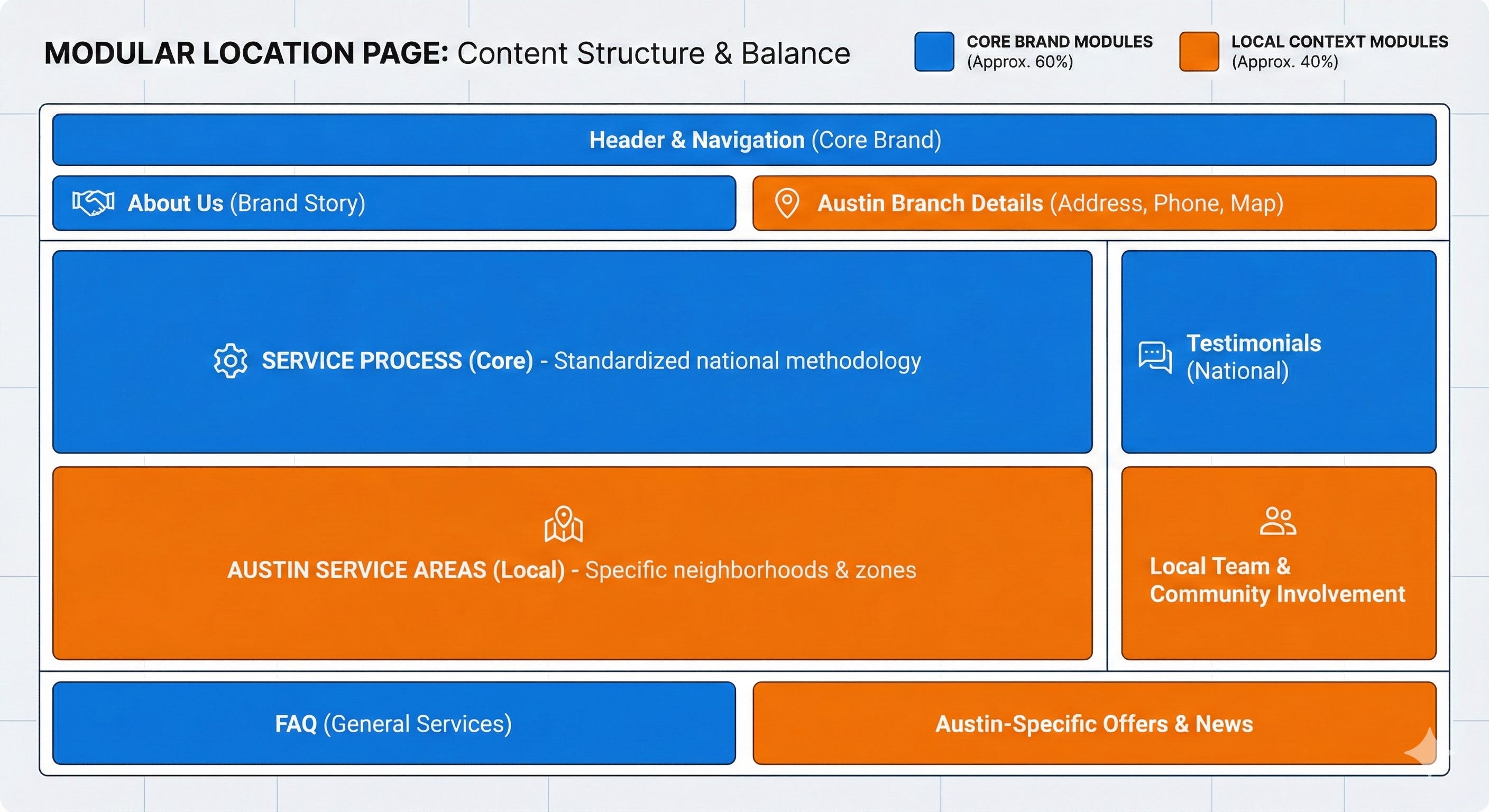
The solution separates your content into core brand modules and local context modules that work together without creating doorway page risks. Core modules stay consistent across all location pages because they represent your brand identity, your service standards, your process, and your value proposition. Local modules change for every location because they reflect market-specific details, competitive positioning, customer concerns, and operational realities that differ by city.
Core brand modules that stay consistent:
Service descriptions and what you offer
Quality guarantees and warranties
Team credentials and certifications
Pricing philosophy and payment options
Process overview and what customers can expect
Brand story and company values
These should stay nearly identical across locations because they represent what makes your brand trustworthy and different from local competitors. A plumber in Austin and a plumber in Dallas working for the same multi-location business should offer the same guarantees and follow the same process. Changing these elements by location dilutes your brand and confuses customers about what they can expect.
Local context modules must differ because they reflect real differences in how you serve different locations with your products or services. The Austin market might need HVAC content focused on extreme summer heat, while the Minneapolis market needs content addressing extreme winter cold. These market-specific details help you boost local relevance without creating doorway pages.
Local context modules that must change per location:
Specific service areas and neighborhoods covered in that city
Common problems homeowners face in that region
Local regulations, permits, or building codes that apply
Seasonal issues unique to that climate or geography
Customer testimonials and reviews from that specific location
Local team members or managers for that market
Operational details like response times or availability windows
Community involvement or local partnerships
These must differ because they reflect real differences in how you serve each area.
Expert Pick: Aim for roughly 60 percent core brand content and 40 percent local context in your location pages. This balance satisfies search engines looking for substantial unique content while maintaining the brand consistency that builds trust with local customers across multiple locations.
The modular system solves the update problem that crushes most multi-location SEO campaigns:
When you need to change pricing or add a new service: Update the core module once, and it propagates to all location pages through your CMS.
When you need to update local content: Edit only the affected locations without touching brand messaging.
When you launch a new location: Populate the template with core modules already complete, then add only the local context modules.
According to Search Engine Land’s local SEO best practices guide, the most successful multi-location brands invest in CMS templates that enforce this separation, making it technically impossible to publish a location page without completing both core and local content requirements.
The balance prevents doorway page penalties while maintaining efficiency.
If 90 percent of your page is core brand content and 10 percent is a token mention of the city name, you are still in doorway territory. If 90 percent is local and 10 percent is brand, you lose the authority signals that come from being part of a larger organization. The 60-40 split adjusts based on how different your markets actually are, but it provides a starting framework that works for most home service businesses across multiple locations.
Get the complete breakdown of which content modules stay consistent and which must change per specific location, with templates, word count guidelines, and real examples from home service brands. Includes checklists for avoiding doorway page penalties and maintaining your local SEO campaign quality.
Google Business Profile (GBP) at Scale
Managing one Google Business Profile listing is straightforward enough for any local business owner. You log in, fill out the fields, upload photos, respond to reviews, and post updates when you remember. Managing 50 listings the same way burns hours every week and creates inconsistencies that confuse search engines and frustrate local customers looking for accurate information about your business locations. Brands operating thousands of locations face even greater challenges without proper systems.
The shift from single-location to multi-location GBP management changes everything.
It requires different tools, different workflows, and different quality control systems than what works for individual listings. One mistake in your naming convention or phone number format multiplies across all locations and takes weeks to fix manually when you are updating each local business listings database separately. This is where most multi-location SEO strategies fail before rankings ever improve.
Verification and Bulk Management
Google verifies single-location profiles through postcard, phone, or email methods that work fine when you operate one location. You wait a few days, enter your verification code, and your listing goes live in local search results. That process does not scale when you need to verify 50 locations in a tight timeline without team members traveling to each business location to retrieve postcards.
Bulk verification requires either the Google Business Profile API or working with a verified third-party management platform that handles multiple business locations simultaneously.
What the API enables for multi-location businesses:
Create and manage profiles programmatically through code
Push updates to multiple locations at once
Verify locations through chain verification if you qualify
Automate routine tasks like post publishing and review monitoring
Track changes and maintain audit logs across all listings
Chain verification is available to brands with 10 or more locations that meet specific criteria, and it replaces individual postcard verification with a streamlined process managed through your authorized account.
Pro Tip: Chain verification requires proving you own and operate all locations legitimately. Google reviews your business structure, website, and existing presence before approving. Start the application process at least 60 days before you need listings live to account for review time.
The challenge with API access requires technical setup, ongoing maintenance, and clear processes for who can make changes and when. Third-party platforms like Yext, Synup, or BrightLocal simplify the interface but add monthly costs and may limit customization options for your specific business needs. According to Local Search Association’s operations research, most brands underestimate the time needed to get bulk management infrastructure working correctly by at least three months.
Without bulk management tools, you end up logging into individual profiles one by one to make updates across multiple locations.
The manual workflow problems:
Updating 50 separate dashboards for every change
Inconsistent wording across locations
Skipped locations when someone forgets to save
No audit trail of who changed what
Hours wasted on repetitive data entry
When you need to change your service list, update holiday hours, or push a promotion across all locations, you are clicking through 50 separate dashboards. That workflow guarantees inconsistencies because someone inevitably skips a location, enters different wording, or forgets to hit save before moving to the next listing.
Did You Know? The other major risk happens when local team members manage their own GBP profiles without coordination. Your Austin manager updates their listing categories one way. Your Dallas manager does it differently. Google sees conflicting signals about what your business actually does, and your local pack rankings suffer across all locations even though each individual listing looks fine in isolation.
Standardization
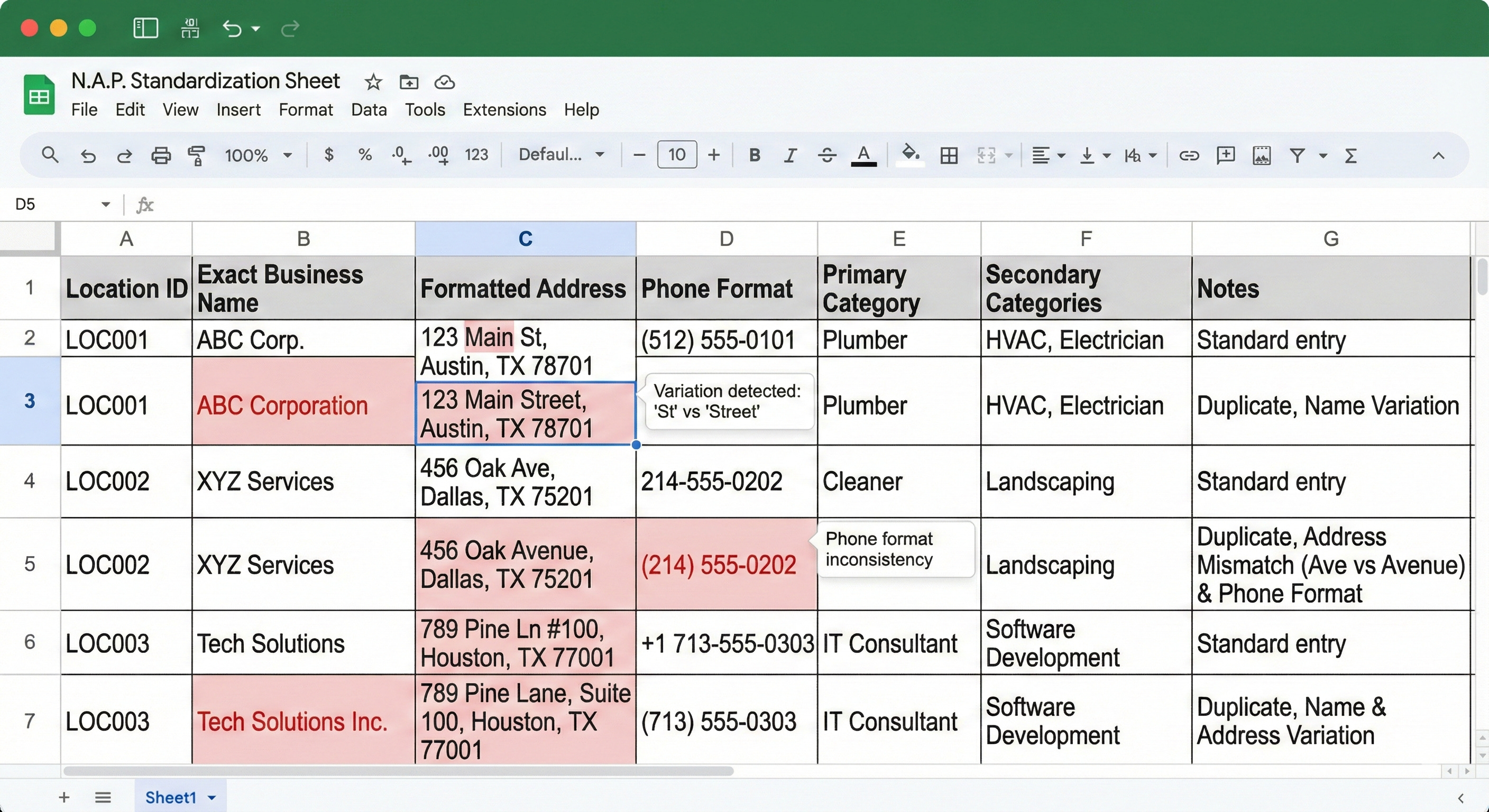
N.A.P. consistency stands for Name, Address, and Phone, and it determines whether Google can confidently connect your business listing to your website, your local citations, and your schema markup across multiple platforms. When these three elements match exactly everywhere they appear online, Google treats your location as a verified, trustworthy entity. When they vary even slightly, Google sees multiple possible entities and may not rank you in local search at all.
The common failures look minor to humans but create massive problems for search engines:
Using “ABC Plumbing - Austin” on GBP but “ABC Plumbing Austin TX” on your website
Formatting phone as (512) 555-1234 in one place and 512.555.1234 in another
Listing address as “123 Main St” on your business listing but “123 Main Street, Suite A” on citation sites
Including suite numbers inconsistently across platforms
Using “Road” on some platforms and “Rd” on others
Each variation seems trivial to the person making the update, but it creates ambiguity for Google’s entity matching algorithms that power local search rankings.
Standardization at scale demands documentation that everyone follows without exception.
What your master N.A.P. reference sheet must include:
Business name format with or without location identifiers
Address format with abbreviations spelled out or shortened
Suite or unit number formatting rules
Phone number format with or without country codes or extensions
Category selections in priority order for each location type
Service list with exact wording and no variations
Hours format and timezone handling for locations spanning regions
Social profile URLs and formatting standards
This master sheet becomes your source of truth for maintaining your online presence across multiple locations. Every GBP update, every local citation submission, every schema markup implementation pulls from this document. When you onboard a new business location, you add a row to the sheet before you create the profile. When you need to update information, you update the sheet first, then push changes to all platforms from that single source.
Expert Pick: Store your N.A.P. standardization document in a shared spreadsheet with version history enabled. Include columns for location identifier, exact business name, formatted address, phone format, primary and secondary categories, service area boundaries, and notes about any location-specific exceptions. Update this before making any changes to live listings.
The documentation also prevents drift over time that ruins multi-location SEO efforts slowly:
Someone abbreviates “Street” in one location because it looks cleaner
Someone adds a keyword to the business name thinking it helps rankings
Local teams update hours without syncing to the master document
New team members create listings without checking standards
Six months later, N.A.P. data is inconsistent across 50 locations
Without the master reference enforcing consistency, you cannot figure out why local pack visibility dropped even though each individual listing looks acceptable.
According to Moz’s Local Search Ranking Factors study, N.A.P. consistency remains one of the top signals affecting local search engine rankings, with inconsistent data cited as the most common technical issue preventing multi-location brands from ranking well even when their on-page SEO is strong.
Technical Signals and Schema Markup
Google understands your location pages through the visible content users see and through the structured data you provide in code. Schema markup translates your entity hierarchy, your location details, and your service offerings into a format search engines can parse reliably without guessing. Without it, Google infers relationships between your pages and may get them wrong. With it, Google knows exactly how your multi-location business is structured.
Most multi-location brands skip schema entirely or implement it inconsistently.
They add LocalBusiness markup to their homepage, Organization markup to random pages, or no markup at all. This creates confusion in Google’s knowledge graph and wastes the authority you built through content and links. The result is lower visibility in local search results even when your on-page SEO is technically correct.
Connecting the Dots with Schema
Your homepage needs Organization schema that defines your parent brand. This tells Google your legal business name, your logo, your social profiles, your contact information, and your overall service offering. It establishes the top-level entity that all your locations connect to in the knowledge graph.
Each location page needs LocalBusiness schema that defines that specific branch.
What LocalBusiness schema must include for each location:
Physical address with complete street, city, state, and postal code
Phone number in consistent format matching your N.A.P. standards
Operating hours including special hours for holidays
Service area boundaries or radius served
Geographic coordinates (latitude and longitude)
Parent organization reference connecting to your brand entity
The connection happens through the “parentOrganization” property, which points back to your brand entity using a unique identifier. Google sees that this local entity is part of a larger organization and can pass trust signals accordingly.
The relationship in code works like this:
Your homepage has Organization schema with a unique @id identifier like “
https://yourbrand.com/#organization”
Your Austin location page has LocalBusiness schema with its own unique @id like “https://yourbrand.com/locations/austin/#localbusiness”
That LocalBusiness schema includes a “parentOrganization” property that references your brand @id
Google connects the dots and understands this location is part of your larger organization
Service pages need Service schema that describes what you offer. If you have location-specific service pages, like “HVAC Repair in Austin,” you combine Service schema with LocalBusiness schema to show both what you do and where you do it.
Pro Tip: Use the @id property consistently across all schema implementations to create a clear entity graph. Every Organization, LocalBusiness, and Service should have a unique @id that other schema types can reference. This helps Google build a complete map of your multi-location business structure.
The properties that matter most for multi-location local SEO:
name: Exact business name matching your N.A.P. standards
address: Complete PostalAddress with streetAddress, addressLocality, addressRegion, postalCode
geo: GeoCoordinates with latitude and longitude values
telephone: Phone number in consistent format
url: Canonical URL for that location page
image: High-quality image representing that location
areaServed: Geographic areas this location serves
openingHoursSpecification: Detailed hours for each day
sameAs: Social profile URLs and directory listings
priceRange: Pricing indicator like “”or”“ or “ “or”$”
According to Google’s structured data documentation, these properties help your business appear in local search results, knowledge panels, and rich results that improve click-through rates.
Consistency between your schema values and your visible page content is critical:
If your schema says “123 Main Street” but your page content says “123 Main St,” Google may not trust either signal
If your schema lists different operating hours than what appears in your GBP, you create conflicting entity information
If your phone number format varies between schema and visible content, it weakens N.A.P. consistency
Your schema must match what users see on the page exactly.
The “hasMap” Property
The hasMap property in your LocalBusiness schema links your page directly to your Google Maps listing. This connection helps Google confidently associate your location page with your physical Map Pack pin, which strengthens your local pack rankings when users search for businesses in that area.
The value of hasMap is the full Google Maps URL for that specific location.
How to get your Google Maps URL for hasMap:
Search for your business on Google Maps
Click on your listing to open the details panel
Click the “Share” button
Copy the full URL from the share dialog
Use that URL as the hasMap value in your schema
It looks like https://www.google.com/maps?cid=YOUR_LOCATION_ID or https://goo.gl/maps/SHORTENED_ID.
When Google crawls your location page and sees hasMap pointing to your Maps listing, it verifies that the page and the listing represent the same entity. This reduces ambiguity, especially in markets where multiple businesses have similar names or operate in overlapping service areas.
Did You Know? Most brands miss the hasMap property because it is not required for schema validation. Your markup will pass Google’s Structured Data Testing Tool without it. But adding it gives Google an explicit signal that improves entity matching and can lift your local pack visibility in competitive markets where small ranking factors make the difference.
The schema implementation workflow at scale uses templates:
Build one master LocalBusiness schema template with variables for location-specific values
Include all critical properties with placeholder values
When you create a new location page, populate the template with that location’s data
Validate the schema using Google’s Rich Results Test
Deploy to production and monitor for errors in Google Search Console
This ensures every location has correct, complete schema without manually writing JSON-LD for each page.
<script type=”application/ld+json”>
{
  /* ==== Base JSON-LD setup ==== */
  “@context”: “https://schema.org”,
  “@type”: “LocalBusiness”,
  /* If you have a specific vertical. you can use “Dentist”, “Restaurant”, “AutoRepair”, etc */
  /* ==== Unique identifiers for this US location ==== */
  “@id”: “https://example.com/locations/san-diego-ca#localbusiness”,
  /* Use the canonical URL for this specific location plus a stable hash fragment */
  “url”: “https://example.com/locations/san-diego-ca”,
  /* Location specific landing page URL */
  /* ==== Core business info . location specific ==== */
  “name”: “Example Family Dental . San Diego”,
  /* Consider including neighborhood or city for clarity */
  “description”: “Example Family Dental is a full service dental office in San Diego. CA offering preventive, cosmetic, and emergency dental care for families.”,
  /* Natural language description. Make it unique per location */
  “image”: [
    “https://example.com/static/img/san-diego-office-front.jpg”
  ],
  /* Storefront or interior image. absolute URL */
  “telephone”: “+1-619-555-1234”,
  /* US phone in international format is safest */
  “priceRange”: “$$”,
  /* $, $$, $$$ etc. Use what matches your market positioning */
  /* ==== Parent organization . multi location brand ==== */
  “parentOrganization”: {
    “@type”: “Organization”,
    “@id”: “https://example.com#organization”,
    /* This @id should match the org level schema on your main site */
    “name”: “Example Family Dental Group”,
    “url”: “https://example.com”
  },
  /* ==== Postal address . US formatted ==== */
  “address”: {
    “@type”: “PostalAddress”,
    “streetAddress”: “1234 Main Street. Suite 200”,
    /* Full street address with suite or unit line if applicable */
    “addressLocality”: “San Diego”,
    /* City */
    “addressRegion”: “CA”,
    /* Two letter USPS state code */
    “postalCode”: “92101”,
    /* Five or nine digit ZIP. 92101 or 92101-1234 */
    “addressCountry”: “US”
  },
  /* ==== Geo coordinates . strongly recommended ==== */
  “geo”: {
    “@type”: “GeoCoordinates”,
    “latitude”: 32.715736,
    /* Replace with the exact latitude of this location */
    “longitude”: -117.161087
    /* Replace with the exact longitude of this location */
  },
  /* ==== Map link . use the real Place ID or CID URL ==== */
  “hasMap”: “https://www.google.com/maps/place/?q=place_id:ChIExamplePlaceId123456”,
  /* Get the exact place_id URL from Google Maps for this location */
  /* ==== Hours of operation . US local time ==== */
  “openingHoursSpecification”: [
    {
      “@type”: “OpeningHoursSpecification”,
      “dayOfWeek”: [
        “Monday”,
        “Tuesday”,
        “Wednesday”,
        “Thursday”
      ],
      “opens”: “08:30”,
      /* Use 24 hour format. 08:30 is 8.30 AM local time */
      “closes”: “17:30”
      /* 17:30 is 5.30 PM */
    },
    {
      “@type”: “OpeningHoursSpecification”,
      “dayOfWeek”: [
        “Friday”
      ],
      “opens”: “08:30”,
      “closes”: “15:00”
    }
    /* Add a separate object for Saturday or Sunday if you are open. or skip if closed */
  ],
  /* ==== Optional but useful for brand/entity signals ==== */
  “sameAs”: [
    “https://www.google.com/maps?cid=12345678901234567890”,
    /* Google Business Profile URL for this location */
    “https://www.facebook.com/examplefamilydentalsd”,
    “https://www.instagram.com/examplefamilydental”
  ]
  /* ==== Optional advanced bits you can add later ====
    “aggregateRating”: {
      “@type”: “AggregateRating”,
      “ratingValue”: “4.8”,
      “reviewCount”: “137”
    },
    “review”: [
      {
        “@type”: “Review”,
        “author”: {
          “@type”: “Person”,
          “name”: “John D.”
        },
        “reviewRating”: {
          “@type”: “Rating”,
          “ratingValue”: “5”
        },
        “reviewBody”: “Super friendly staff and very clean office.”
      }
    ]
  =================================================== */
}
</script>
Common schema mistakes that hurt multi-location SEO:
Missing the parentOrganization connection between locations and brand
Using inconsistent @id values that break entity relationships
Omitting geographic coordinates that help with proximity ranking
Listing service areas that contradict your actual coverage
Using the same schema across all locations with only address changed
Not updating schema when business information changes
According to Search Engine Land’s schema implementation guide, properly structured schema can improve local search visibility by 20 to 30 percent in competitive markets where multiple businesses target the same keywords and service areas.
Expert Pick: Validate your schema implementation using three tools: Google’s Rich Results Test for markup correctness, Schema.org validator for specification compliance, and manual inspection in Google Search Console for how Google actually interprets your structured data. All three must pass for optimal results.
Reputation and Citations
Your on-site optimization and schema markup tell Google what you claim to be. Your off-site reputation signals tell Google whether other sources agree. Local citations and online reviews validate your entity information, prove you operate legitimately in each market, and influence whether Google ranks you in the local pack when users search for businesses like yours. This reputation management is critical for multi-location seo success regardless of market size.
Single-location businesses can manage citations and reviews manually without systems or automation.
Multi-location brands need workflows that scale without creating duplicates, outdated listings, or inconsistent data that damages rankings across all locations. The transition from managing one listing to managing 50 requires different tools, different processes, and different quality control than what works for individual local businesses. Your local audience expects accurate information everywhere they encounter your brand.
Data Aggregators vs. Manual Citations
Local citations are mentions of your business name, address, and phone number on external websites. Google uses them to verify that your locations exist and to cross-check the accuracy of your GBP information against what other authoritative sources say about your business. According to Moz’s Local Search Ranking Factors study, citation signals remain among the top factors influencing local pack rankings, with N.A.P. consistency across citations directly impacting visibility.
You build citations through two channels that serve different purposes.
Data aggregators distribute your information to hundreds of directories, review sites, and map platforms automatically through their data networks. Manual citations involve submitting your information directly to high-value local directories, industry-specific platforms, and geo-targeted sites that aggregators do not cover in their standard distribution.
Major data aggregators for multi-location businesses:
Neustar Localeze: Distributes to over 100 platforms including Apple Maps and Bing
Acxiom: Powers data for numerous navigation systems and business directories
Factual: Supplies location data to major apps and search engines
Foursquare: Feeds location intelligence to consumer apps and platforms
One submission to an aggregator reaches dozens or hundreds of sites automatically. This solves the volume problem for multi-location brands. You cannot manually submit 50 locations to 100 directories each. That is 5,000 individual submissions, most of which would be outdated within months as business information changes.
The tradeoff with aggregators:
They cover breadth but miss depth. They get your data onto major platforms but skip niche directories that matter in specific markets or industries. A plumbing brand benefits from citations on local chamber of commerce sites, regional trade association directories, and city-specific service listings. Aggregators rarely include these high-value local citations because they focus on national coverage.
Manual citation building focuses on the high-value, location-specific opportunities aggregators miss. These best seo opportunities for local relevance include:
Local business associations and chambers of commerce
City government directories and official business registries
Regional news sites and community calendars
Industry-specific platforms where target customers research providers
Local event listings and sponsorship directories
Neighborhood association websites and community resources
Pro Tip: Use data aggregators for baseline coverage across all locations, then prioritize manual citation building for your must-win markets. Your top 10 markets get dedicated citation work with 20 to 30 manually built local citations each. Your secondary markets rely on aggregator coverage until performance justifies more investment.
The workflow at scale for multi-location citation building:
Submit all locations to the four major data aggregators
Wait 60 to 90 days for aggregator distribution to complete
Audit which citations appeared and which platforms still need manual submission
Build a prioritized list of 50 high-value directories for your industry
Submit your must-win markets to all 50 directories manually
Submit secondary markets to the top 10 directories only
Monitor citation accuracy quarterly and fix inconsistencies immediately
Citation consistency matters more than citation volume for local search rankings.
Ten accurate citations across authoritative sites outperform 100 citations with inconsistent formatting or outdated information. Every citation that lists the wrong phone number or an old address tells Google your entity data is unreliable, which directly harms your ability to rank in local search results.
According to BrightLocal’s Local Citation Impact Study, 68 percent of consumers lose trust in a local business when they encounter inconsistent information across online listings, and Google’s algorithms similarly reduce ranking confidence for businesses with citation inconsistencies.
Did You Know? The biggest citation management mistake multi-location brands make is building hundreds of citations quickly without a system for updating them when information changes. When you update your phone number or move a location, you need to update every citation. Without tracking which citations exist for each location, you end up with outdated information permanently embedded in citation networks.
Automating Review Generation
Reviews impact local rankings directly and conversion rates indirectly when potential customers evaluate your business. A location with 50 recent five-star reviews outranks a competitor with five old reviews, even when other ranking signals are equal. Research from BrightLocal’s Local Consumer Review Survey shows that 98 percent of consumers read online reviews for local businesses, and review recency matters as much as overall rating when they make hiring decisions.
The challenge at scale is generating consistent review velocity across 50 locations.
Each location has different staff, different customer volume, and different motivation levels. Your Austin location might ask every customer for a review and average 10 new reviews per month. Your Dallas location might forget to ask and average one review per quarter. Google sees this disparity and may question whether your Dallas location is actually active or serving customers regularly.
Review velocity means the rate at which new reviews appear over time, not just the total review count:
A location earning two reviews per week signals active customer engagement
A location that earned 50 reviews two years ago and nothing since signals stagnation
Consistent monthly review generation proves ongoing operations and service quality
Sudden spikes followed by long gaps look suspicious to search engines
Review velocity affects local search rankings according to multiple studies. Steady, consistent review generation across all your business locations outperforms sporadic bursts of reviews that suggest manipulation or incentivized campaigns.
Automation solves the consistency problem by removing human variability.
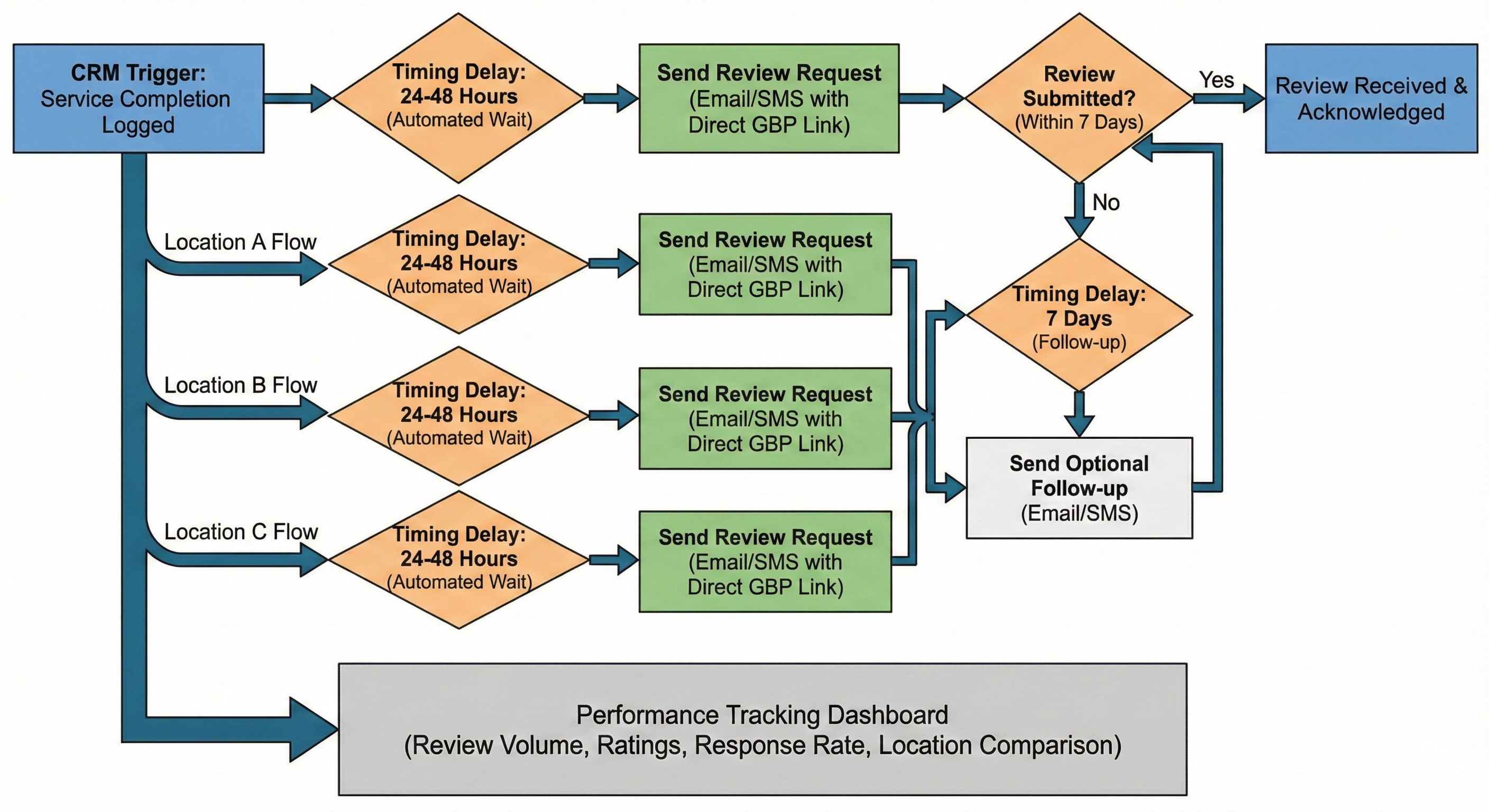
How automated review generation works for multi-location businesses:
Integrate your CRM or service completion system with review request software
Trigger review requests automatically after service completion
Send requests 24 to 48 hours after the job when experience is fresh
Use the same message template across all locations for consistency
Include direct links to your Google Business Profile review page
Send one gentle follow-up reminder if no response after 7 days
Track response rates by location and coach underperforming teams
The automation standardizes the ask across multiple locations. Every customer gets the same message, the same tone, and the same direct link to leave a review. This removes the variability that comes from individual staff members remembering to ask, feeling comfortable making the request, or having time during busy periods.
Expert Pick: Your review request should make leaving a review as frictionless as possible. Use a direct Google review link that opens the review interface immediately, not a link to your website where customers need to find the review section. Keep the message short and explain why feedback matters without guilting or incentivizing them, which violates Google’s review policies.
Elements of an effective automated review request:
Personal greeting using the customer’s name
Brief thank you for choosing your business
Direct request for honest feedback about their experience
One-click link to your Google Business Profile review page
Optional mention that reviews help other local customers make decisions
No incentives, discounts, or rewards tied to leaving reviews
The system should aggregate review performance data so you can see which locations generate reviews and which fall behind:
Review management tools for multi-location brands:
Podium: SMS-based review requests with multi-location dashboard
Birdeye: Comprehensive reputation management across multiple platforms
Grade.us: Automated review generation with location-level analytics
ReviewTrackers: Monitoring and response management at scale
According to Search Engine Land’s review impact research, businesses that respond to reviews see 12 percent higher local search rankings than those that ignore reviews, even when review volume is similar. Your automation should include response workflows, not just request workflows.
The complete review system for multi-location SEO includes:
Automated review requests triggered by service completion
Location-level performance tracking showing review velocity trends
Response templates for common review types (positive, neutral, negative)
Escalation workflows for reviews mentioning specific issues
Monthly reporting showing which locations need coaching or process improvements
This visibility lets you coach underperforming locations, investigate operational issues causing low review rates, and replicate successful tactics from your best-performing markets across all your business locations.
Pro Tip: Never buy reviews, incentivize only positive reviews, or pressure customers to change negative reviews. These tactics violate Google’s policies and can result in review removal, GBP suspension, or permanent ranking penalties that affect all your locations. Consistent, authentic review generation always outperforms shortcuts.
Growth, Tracking, and Attribution
You can build perfect location pages, optimize every Google Business Profile, and generate consistent reviews across all markets. If you cannot track which locations drive revenue and which waste budget, you cannot make informed decisions about where to invest next or which local SEO strategies actually work for your multi-location business. Effective tracking combines seo and digital analytics to measure complete attribution.
Multi-location SEO requires location-level attribution that single-location tracking does not provide.
You need to know which cities generate calls, which generate form fills, and which generate neither despite high traffic. You need to see how building local links to a specific location page impacts rankings and conversions in that market. Without this visibility, you optimize blindly and justify budget based on gut feeling instead of data that shows actual SEO success.
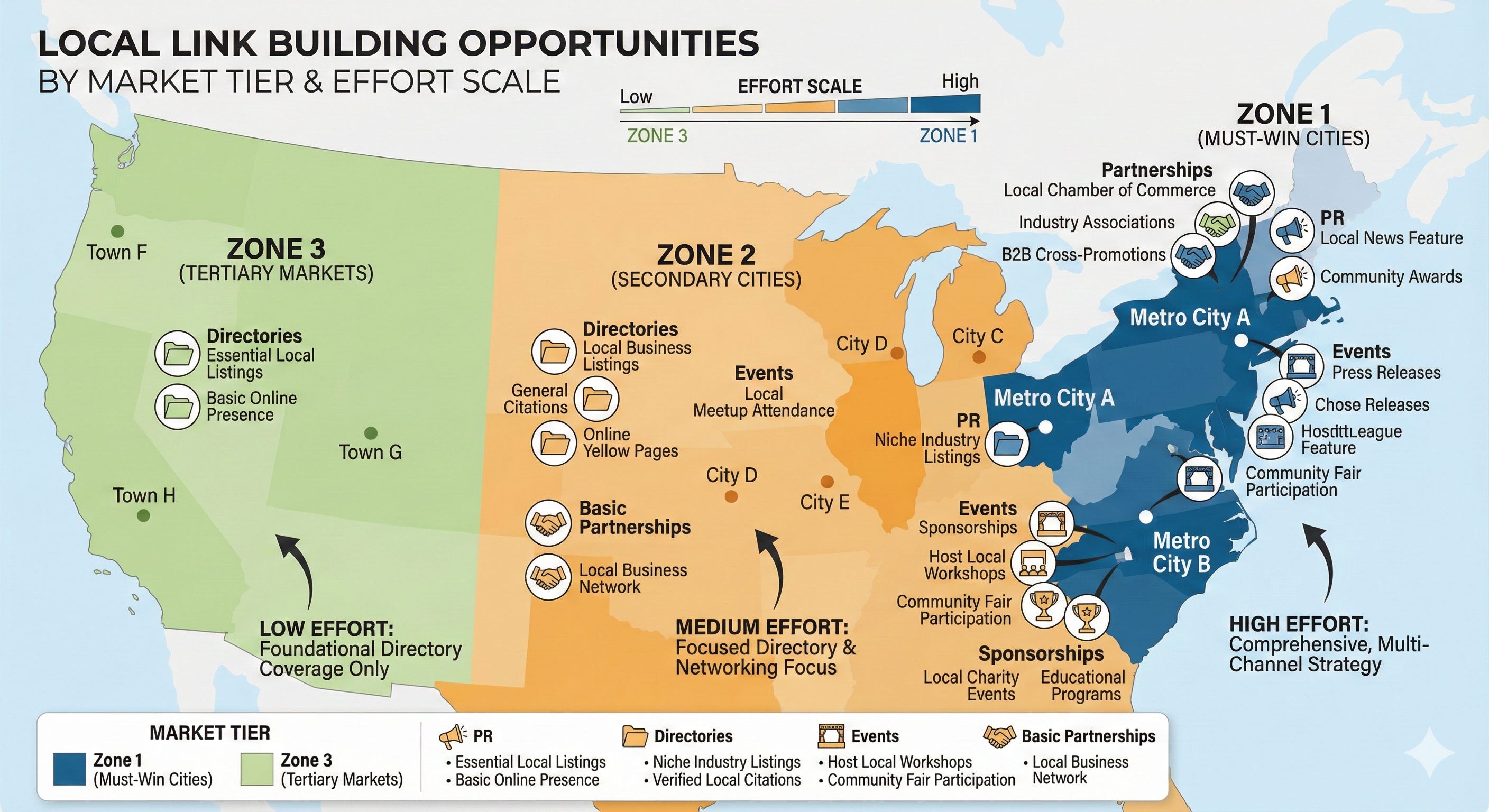
Local Link Building
Links to your homepage build domain authority that flows to all pages through your internal link structure. Links to specific location pages build topical relevance and geographic authority that tells Google this page deserves to rank in that specific local market when users search for relevant services there.
The difference matters in competitive local markets where multiple brands compete.
If you are competing for “plumber Austin” against five other multi-location brands, the one with local backlinks from Austin-based sites, Austin news coverage, and Austin business directories has a clear advantage. Homepage links do not signal local relevance the way location-specific links do for rankings in local search results.
Local link opportunities that work for multi-location businesses:
City business directories and chamber of commerce member listings
Local chamber websites and economic development organizations
Regional news outlets covering your industry or local business topics
Local event sponsorships with links from event websites
Partnerships with other businesses serving the same geographic market
Community organization sponsorships and nonprofit partnerships
Local blogger outreach for neighborhood guides and resource lists
City-specific resource pages and service provider directories
A roofing company that sponsors a local youth sports league and gets a link from that league’s website earns a relevant local signal. A plumbing company featured in a local news article about home maintenance tips earns both a link and brand awareness in that specific market.
Pro Tip: The challenge at scale is you cannot manually build links to 50 location pages the same way you might for a single location. The strategy shifts to identifying scalable patterns and prioritizing high-value markets based on competitive intensity and revenue potential.
Scalable local link building patterns for multiple business locations:
Get listed in state and city-level business directories that cover all your locations
Create local partnership programs you can replicate across markets
Develop newsworthy local content that regional outlets want to cover
Build relationships with industry associations that maintain member directories
Sponsor community events in multiple cities using the same partnership model
A case study about a major project in Austin becomes a template for creating similar case studies in Dallas, Houston, and San Antonio. The content format stays consistent while the local details change, making it efficient to produce link-worthy content across all locations.
Prioritization follows the same logic as your market strategy from Phase 1:
Must-win markets: Dedicated local link building with 10 to 20 quality local links per quarter
Secondary markets: Scalable tactics like directory submissions and partnership programs
Ignore markets: No link building until they become secondary or must-win priorities
Link velocity matters as much as total link count for effective local SEO.
A location page that earns one or two quality local links per quarter signals ongoing relevance and activity. A page that earned 20 links at launch and nothing since looks stagnant to search engines and may lose rankings over time even if the links remain live.
Did You Know? According to Whitespark’s Local Search Ranking Factors survey, local link signals account for approximately 16 percent of the factors that determine local pack rankings, with links from locally relevant domains carrying significantly more weight than generic links from non-local sources.
The quality threshold for local links differs from traditional SEO link building best practices:
A link from a small local blog or a regional business association may not have high domain authority measured by tools like Moz or Ahrefs. But it carries strong local relevance signals that matter for local pack rankings. Do not ignore these opportunities just because the linking domain does not pass traditional SEO metrics for authority.
Quality indicators for local links across multiple locations:
Geographic relevance: The linking site serves the same local market
Topical relevance: The linking site covers related industries or services
User value: Real users might click the link to find your business
Editorial placement: The link appears in content, not just a directory listing
Local authority: The site is recognized in that community
Segmenting Data in GA4
Google Analytics 4 tracks sessions, events, and conversions at the site level by default. You see total traffic, total form submissions, and total revenue aggregated across your entire online presence. For a multi-location brand, this data is nearly useless for decision making because you cannot tell which locations perform and which bleed budget without delivering results.
Location-level tracking requires setting up custom dimensions and events that tag each session with the location it represents.
When someone visits your Austin location page, fills out a form, and becomes a customer, GA4 should attribute that conversion to Austin specifically. This lets you compare performance across markets, identify which local SEO efforts work, and shift budget toward locations that generate measurable business outcomes.
The setup process for multi-location GA4 tracking:
Define a location parameter that captures the city or location identifier from the URL or page content
Pass that parameter to GA4 as a custom dimension using Google Tag Manager or direct implementation
Create calculated metrics for location-specific conversion rates and revenue
Build custom reports segmenting all data by location dimension
Set up alerts for significant changes in location-level performance
According to Google’s GA4 custom dimensions documentation, you can create up to 50 custom dimensions per property, which is sufficient for most brands with multiple locations. Each dimension can have up to 100 unique values, so you can track individual cities or group them by region depending on your reporting needs.
Expert Pick: Create two location dimensions in GA4. One for the specific city (Austin, Dallas, Houston) and one for the region or state (Texas, Florida, California). This lets you analyze performance at both granular and aggregate levels without rebuilding your tracking as you scale to new markets.
Once the dimension exists, you can segment every report by location:
Traffic by city showing which markets generate the most visits
Conversion rate by city revealing which locations turn visitors into leads
Revenue by city quantifying which markets justify continued investment
Average session duration by city indicating content quality and user engagement
Bounce rate by city highlighting potential UX or relevance issues
The segmentation also reveals operational issues that hurt SEO success:
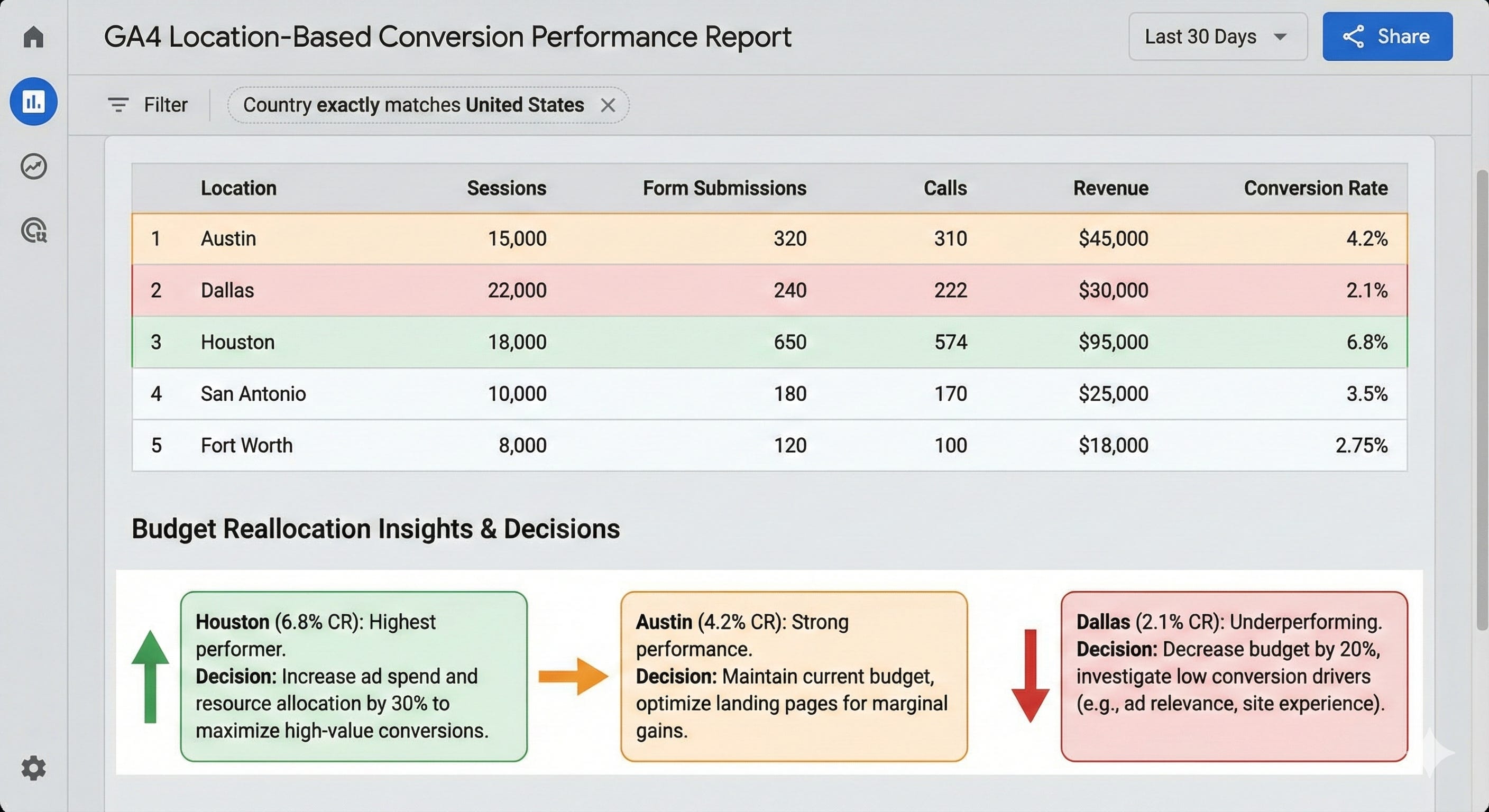
If your Austin page has high traffic but low conversions compared to Dallas, you might have a local pricing problem, a weak call to action, or a mobile UX issue specific to that page. If your Houston page has low traffic despite strong local SEO work, you might need more aggressive building local links or better GBP optimization.
Pro Tip: Call tracking adds another layer of attribution for businesses where phone calls drive most conversions. Use unique phone numbers for each location page and GBP listing, then track which numbers generate inbound calls. This ties phone conversions back to specific locations the same way form fills tie to pages.
Call tracking implementation for multi-location businesses:
Use dynamic number insertion on location pages to show unique tracking numbers
Display the same tracking numbers in your GBP listings for consistency
Route calls to appropriate locations while capturing source data
Integrate call tracking with GA4 to see complete attribution
Track call duration and outcomes to measure lead quality by market
Tools like CallRail, CallTrackingMetrics, or Invoca handle multi-location call tracking with GA4 integration built in. According to Search Engine Journal’s call tracking analysis, businesses that implement location-specific call tracking see 30 to 40 percent better budget allocation decisions because they can accurately measure which local markets generate actual customer conversations.
The complete attribution picture combines three data sources:
GA4 location tracking: Website visits, form submissions, page engagement
Call tracking: Phone conversions, call duration, call outcomes by location
GBP insights: Direction requests, website clicks, call button clicks from Maps
You see which locations drive website visits, which drive calls, which drive direction requests, and which drive zero engagement despite optimization efforts. This tells you where to double down and where to cut losses before wasting more budget on markets that do not perform.
Reporting cadence for tracking local SEO success across multiple locations:
Weekly: Monitor traffic and conversion spikes or drops by location
Monthly: Review location-level performance trends and adjust tactics
Quarterly: Make strategic budget shifts between locations based on ROI
Annually: Decide which new markets to enter and which existing markets to exit
The key SEO metrics to track for each location:
Organic traffic volume from local search queries
Local pack appearances for target keywords
Click-through rate from local search results
Conversion rate from organic visitors
Cost per acquisition by location
Revenue per location from organic channel
Rankings for location-specific keywords in Google Search Console
Phone calls attributed to organic search
Direction requests from GBP listings
According to Moz’s guide to local SEO KPIs, the most successful multi-location brands track at least 10 metrics per location and review them monthly to catch performance changes before they become major problems requiring expensive fixes.
Did You Know? Google Search Console provides location-specific data when you filter by query. Search for “plumber austin” and you can see which of your pages rank for that query, what position they hold, and how click-through rates compare to other locations. This helps identify ranking opportunities and content gaps across your various locations.
The Future of Local (AI & GEO)
Google’s Search Generative Experience, Bing Copilot, Perplexity, and ChatGPT are changing how people find local businesses. Instead of clicking through ten blue links to compare options, users ask conversational questions and get synthesized answers with three to five recommended businesses embedded directly in the response. If your multi-location brand is not optimized for these AI-powered surfaces, you lose visibility even when your traditional local SEO is strong.
This shift is not theoretical or distant future speculation.
According to Search Engine Land’s analysis of SGE rollout data, Google’s AI-powered search features now appear for a significant portion of commercial and local search queries. The format fundamentally changes what “ranking” means and which signals determine visibility when users search for local businesses in specific markets.
Optimizing for “Best X Near Me” in AI
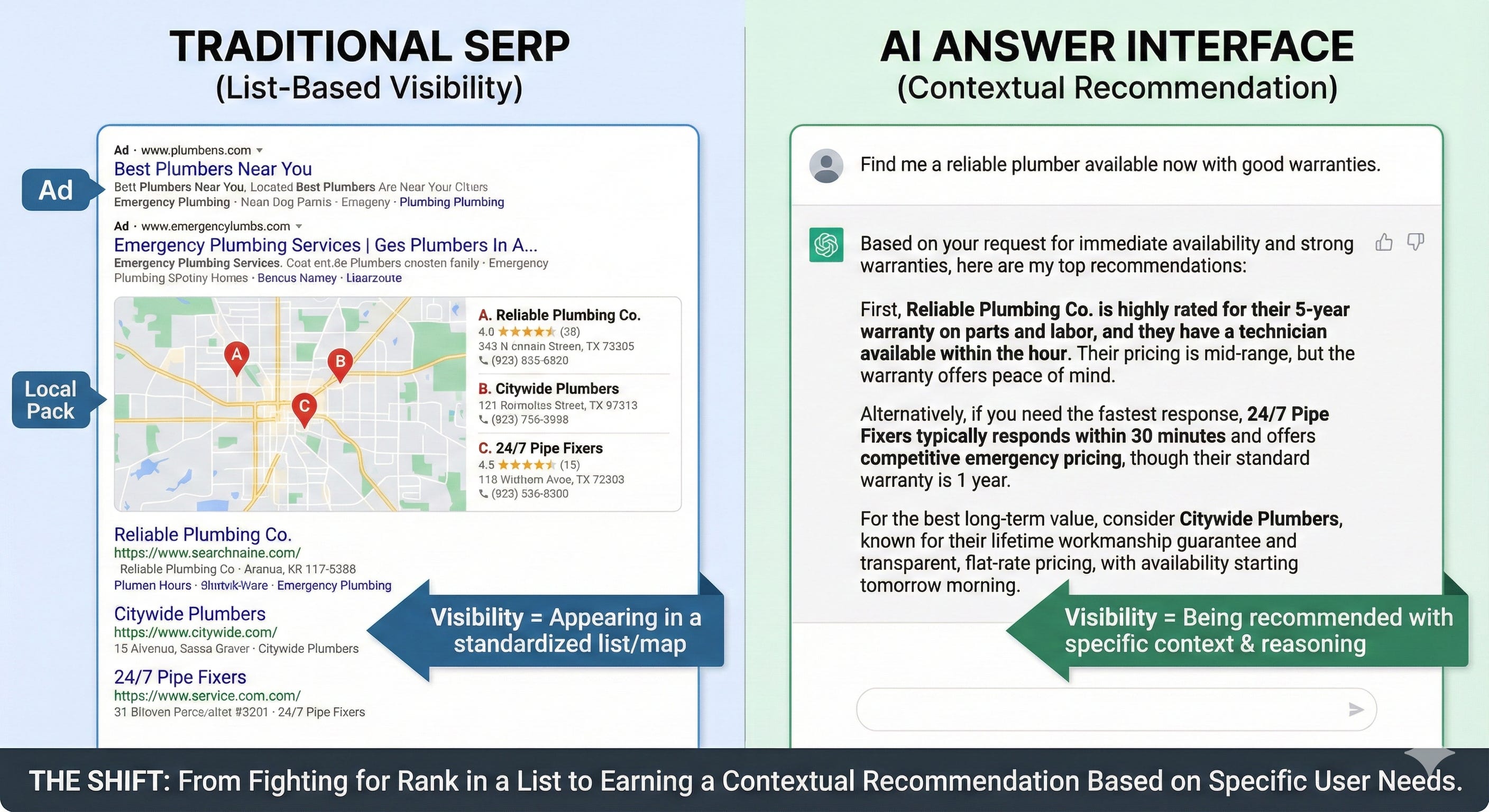
Traditional local search returns a Map Pack with three businesses, a list of organic results below it, and ads at the top. Users scan the options, click a few to compare details, read reviews, check websites, and then decide. The job of Local SEO is to appear in that Map Pack or rank high in organic results where users can see your business listing.
AI search returns a conversational answer that synthesizes information from multiple sources and recommends specific businesses inline with reasoning.
What AI-powered search results look like:
The AI might say “For emergency plumbing in Austin, consider ABC Plumbing, which has 24/7 availability and strong reviews for fast response times, or XYZ Plumbing, known for transparent pricing and warranty coverage.” The answer continues with specific reasons why each business matters based on what the AI learned from multiple sources about your online presence.
The user does not see a list of ten options to evaluate independently. They see two or three recommendations with specific reasons explaining why each fits their needs. If your business is not one of those recommendations, you are invisible regardless of your traditional rankings in Google Search results.
Pro Tip: The AI systems decide which businesses to recommend based on how clearly your content answers specific questions users ask. Generic service descriptions that explain what you do without addressing common customer concerns provide weak signals for AI to work with.
This changes optimization strategy in three fundamental ways for multi-location businesses:
Your content must answer specific questions about your service, not just describe what you do
AI systems pull from pages that directly address “how fast do you respond,” “what does it cost,” “do you offer warranties,” “what makes you different from competitors,” and “do you serve my specific location.” Generic service descriptions do not provide enough signal for the AI to confidently recommend you over competitors.
Your entity data must be complete and consistent across all platforms
AI systems aggregate information from your website, your GBP, your schema markup, your local citations, and your online reviews to build a composite understanding of your business. Inconsistencies create ambiguity that reduces confidence. Missing data means the AI has less to work with when deciding whether to recommend you in local search results.
Your content must demonstrate expertise and trustworthiness in ways AI systems can verify
This means citing your credentials, explaining your process in detail, showing proof of results with specific examples, and earning mentions from authoritative sources in your market. AI systems are designed to favor sources with clear E-E-A-T signals, which stands for Experience, Expertise, Authoritativeness, and Trustworthiness as outlined in Google’s Search Quality Rater Guidelines.
The term for this optimization approach is Answer Engine Optimization, or AEO.
Instead of optimizing to rank for a keyword in traditional search results, you optimize to be cited as the answer to a question. The tactics overlap with traditional Local SEO but the content structure and information density requirements are different.
Content elements that help AI systems recommend your business:
Direct answers to common questions in the first paragraph of relevant sections
Specific details about pricing, availability, service areas, and processes
Clear statements of credentials, certifications, and years in business
Customer testimonials with specific outcomes and problem solutions
Comparisons showing when your service fits versus when it does not
Process explanations that walk through what customers can expect
Seasonal or regional considerations that apply to specific markets
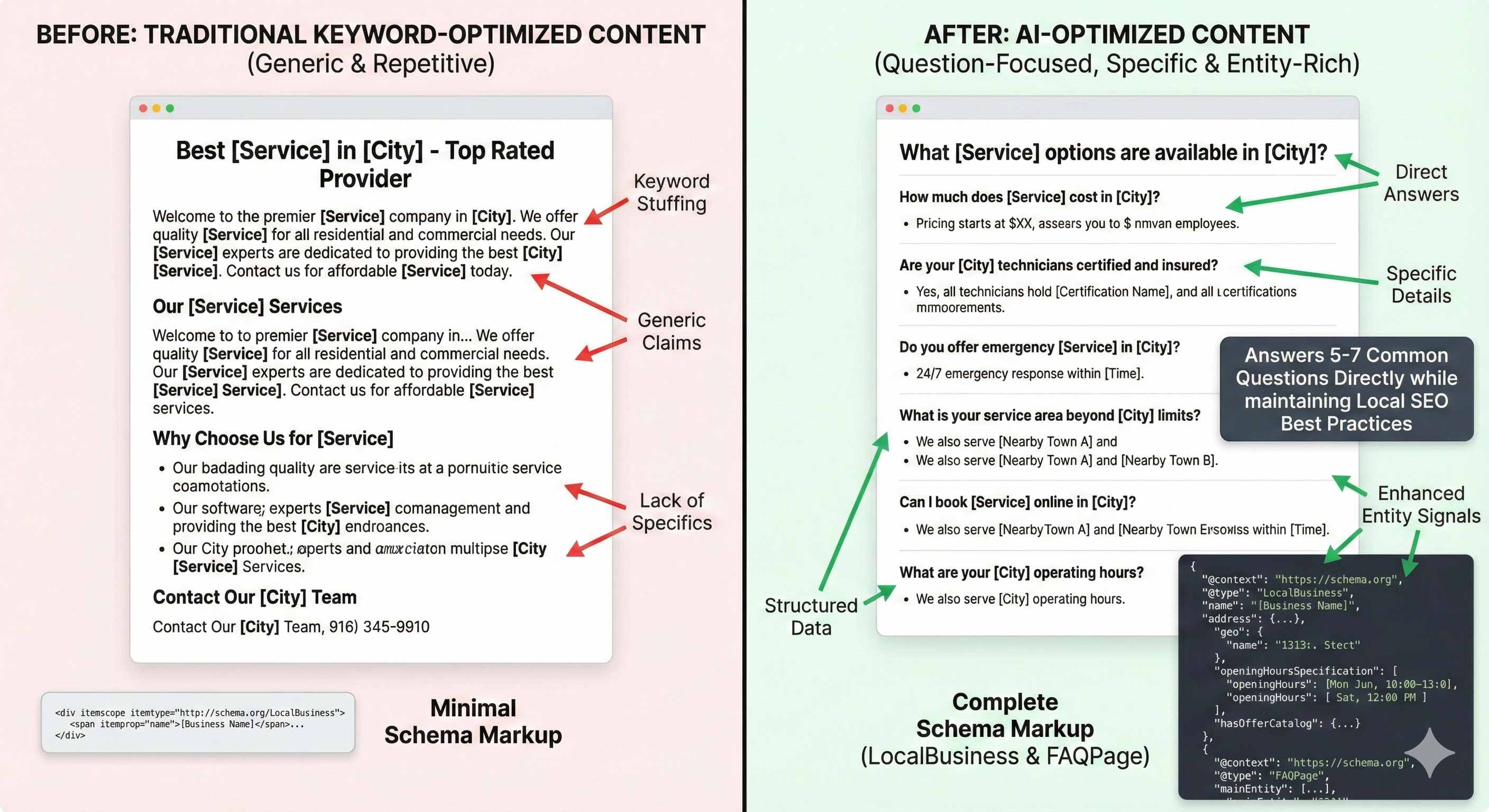
For multi-location brands, this means your location pages need question-focused content that addresses the specific concerns users have in that market. Your Austin page should answer “what plumbing problems are common in Austin homes” and “how do Austin building codes affect plumbing repairs.” Your Dallas page should answer the Dallas-specific versions of those questions with local context.
Did You Know? According to BrightEdge’s research on AI search impact, 84 percent of search queries now trigger some form of AI-generated content in search results, and businesses that optimize specifically for AI visibility see 25 to 35 percent higher click-through rates from AI-powered search features compared to traditional organic listings.
The AI systems also consider recency and update frequency when deciding which sources to cite:
A location page last updated two years ago signals stagnation
A page with fresh content, recent reviews, and current information signals active operation
Regular updates to hours, services, and local details improve AI confidence
Outdated information that contradicts other sources reduces recommendation likelihood
Generative Engine Optimization, or GEO, is the broader term for optimizing across all AI-powered search interfaces, not just Google’s SGE. It includes Bing Copilot, Perplexity, ChatGPT with search capabilities, and any other platform that uses large language models to generate answers instead of returning traditional search results.
Expert Pick: The common thread across all these platforms is they synthesize information from multiple sources and prioritize clarity, specificity, and verifiable expertise. Your content must be structured to make extraction and synthesis easy, which means clear section headings, direct answers early in each section, and explicit statements of what you offer and how you deliver it.
Content structure requirements for AI optimization across multiple locations:
Use descriptive H2 and H3 headings that match how users phrase questions
Lead each section with a direct answer before adding explanation
Include specific details rather than vague generalities about your services
Add structured data that explicitly defines your entity relationships
Maintain consistent N.A.P. data across all platforms search engines crawl
Update content regularly to show active operation and current information
Build local citations that validate your presence in each specific location
The multi-location complexity requires balancing traditional Local SEO signals with AI optimization requirements without creating thin content or doorway pages. This is where the modular content system from Phase 3 becomes critical for SEO for multi-location businesses.
How the modular system supports AI optimization:
Core brand content provides the depth and expertise signals AI systems look for
Local modules provide the market-specific context AI needs to recommend you for location-based queries
The combination satisfies both users searching and search engines evaluating quality
Updates to core content improve AI understanding across all locations simultaneously
Updates to local content maintain relevance for specific market conditions
According to Search Engine Journal’s GEO implementation guide, multi-location brands that implement question-focused content structure see 40 to 50 percent higher citation rates in AI-generated answers compared to brands using traditional keyword-optimized content alone.
Pro Tip: Test how AI systems currently describe your business by asking ChatGPT, Perplexity, and Bing Copilot questions like “What are the best [your service] companies in [your city]?” The answers reveal what information they can extract from your online presence and what gaps exist in your content or entity data.
Testing and monitoring AI visibility for your multi-location business:
Query major AI platforms monthly with location-specific questions about your industry
Track whether your business appears in AI-generated recommendations
Analyze what specific details AI systems cite when they mention you
Identify gaps where competitors get recommended but you do not
Update content to address the questions AI systems cannot currently answer about your business
Monitor how changes to your content affect AI citation rates over 30 to 60 days
The measurement challenge is AI search does not provide the same analytics traditional search engines offer. You cannot see impression data or click-through rates from AI-generated answers the way you can in Google Search Console. This requires different tracking approaches focused on outcomes rather than traditional SEO metrics.
Proxy metrics for tracking AI search performance:
Branded search volume increases as AI exposes more users to your business
Direct traffic increases from users who discover you in AI answers
Conversion rate improvements from higher-intent visitors AI recommends
Geographic diversity in traffic as AI recommends you in new markets
Phone call volume from users who got your details in AI responses
The future-ready local SEO approach combines traditional signals with AI optimization:
Traditional Local SEO signals that still matter:
Google Business Profile optimization with complete, accurate information
Local citations validating your presence in each market
Online reviews demonstrating customer satisfaction and service quality
Local backlinks proving relevance in specific geographic markets
On-page SEO with proper location targeting and service descriptions
Schema markup connecting your entity hierarchy explicitly
New AI optimization signals gaining importance:
Question-focused content structure matching conversational search queries
Specific details AI can extract and synthesize into recommendations
Expertise signals AI systems can verify through credentials and citations
Recency signals showing your business operates actively in each location
Entity completeness across all platforms AI systems reference
Content depth that supports confident recommendations with reasoning
The brands that win in AI search are the ones that satisfy both traditional search engines and AI systems simultaneously. This is not about choosing one approach over the other. It is about understanding that AI-powered search surfaces require additional optimization layers on top of the local SEO best practices you already implement.
Did You Know? Mike Blumenthal, a local search expert and founder of GatherUp, noted in his analysis of AI impact on local search marketing, “Multi-location brands that wait to optimize for AI search will find themselves invisible in the channels where users increasingly discover and evaluate businesses, even if their traditional rankings remain strong.”
The Multi-Location Roadmap
Start with your entity strategy and market prioritization before you build a single page. Map which cities matter most, define how your parent organization connects to individual locations, and document your N.A.P. standards that everyone follows without exception. This foundation determines whether everything you build after scales cleanly or creates problems you will spend months fixing when you launch your seo campaign for a multi-location business.
Your first implementation step is auditing your current entity structure and prioritizing your must-win markets.
Use revenue potential, competitive advantage, and operational capacity as your scoring criteria. Build those locations first with full optimization across all eight phases. Launch secondary markets only after your priority locations perform and you have clean data proving which tactics actually move rankings in local search results for your business.
The spoke that matters most right now is your entity structure and location targeting strategy. That guide walks through the complete market prioritization framework, the parent organization versus LocalBusiness distinction, and how to map service areas without creating thin content or doorway page risks that trigger penalties.
If you need help building your multi-location local SEO architecture or want someone to audit your current setup and identify what blocks growth across your various locations, this is the kind of work I do one-to-one with home service brands and agencies running multiple businesses.
Implementation Checklist
Use this checklist to work through each phase systematically.
Phase 1: Foundation
Define your entity hierarchy and document parent organization versus individual location structure in a master reference sheet.
Prioritize markets into must-win, secondary, and ignore categories based on revenue, competition, and capacity using a scoring matrix.
Phase 2: Technical Architecture
Choose subfolder URL structure (/locations/city) and map internal linking flow from homepage through state, city, and service pages.
Document your URL naming conventions and internal linking rules before building any location pages.
Phase 3: Content Framework
Build modular content system with 60 percent core brand modules and 40 percent local context modules to avoid doorway page penalties.
Create templates that enforce this separation and make it impossible to publish without both module types.
Phase 4: GBP Management
Set up GBP bulk management tools or API access for programmatic updates across multiple business locations.
Document N.A.P. standards in a master spreadsheet that becomes your single source of truth for all listings.
Implement chain verification if you qualify with 10+ locations.
Phase 5: Schema Markup
Add Organization schema to homepage with unique @id identifier.
Add LocalBusiness schema with hasMap property and parentOrganization reference to all location pages.
Validate schema using Google’s Rich Results Test, Schema.org validator, and Search Console.
Phase 6: Citations and Reviews
Submit all locations to four major data aggregators for baseline coverage.
Build 20 to 30 manual local citations for must-win markets focusing on high-value local directories.
Launch automated review request system triggered 24 to 48 hours after service completion with direct GBP links.
Phase 7: Tracking and Links
Configure GA4 custom dimensions for location-level tracking across all your business locations.
Set up call tracking with unique numbers per location integrated with GA4.
Build 10 to 20 quality local links per quarter for must-win markets using scalable partnership patterns.
Phase 8: AI Optimization
Audit location pages for question-focused content structure that AI systems can extract and synthesize.
Test how AI platforms currently describe your business and identify gaps in entity data or content depth.
Update location pages to include specific answers to common questions with local context unique to each market.
Ongoing Maintenance
Review location-level performance monthly in GA4 and shift budget toward markets that drive measurable conversions.
Update N.A.P. data in master spreadsheet first, then push changes to all platforms to maintain consistency.
Monitor review velocity by location and coach underperforming teams on request processes.
Build new local links quarterly for must-win markets to maintain ranking momentum.